Pollo AI is used for creating AI-generated music videos with visual scenes, storyboards, subtitles, characters, etc.
5 Best AI Music Video Generators for Modern Creators in 2026

Updated On September 23, 2026

The AI music video generating ecosystem is evolving day by day, and heading towards betterment with every update. Its multi-layered creative infrastructure is easy to understand and use; that’s why it supports independent musicians, marketers, digital creators, and a lot of people that wants to use technology with their creativity.
They just have to type a prompt for whatever they want: music, a document, a script for their next video, and many things that they can get done by just describing a little.
This article is about the five best AI generators that produce music efficiently, and exactly the way you want it. You just have to describe the mood, rhythm, lyrics, and additions you want, and within seconds, you have your music ready.
Table of Contents:
- Pollo AI for automated music-to-story video workflows
- Why Pollo AI stands out as an AI music video generator
- Kling AI for cinematic motion and visual storytelling
- Pika for rapid concept testing and visual experimentation
- Runway Gen-3 Alpha for advanced motion and professional control
- Luma Dream Machine for realistic spatial and atmospheric video generation
- Conclusion
- Frequently Asked Questions
Pollo AI for automated music-to-story video workflows
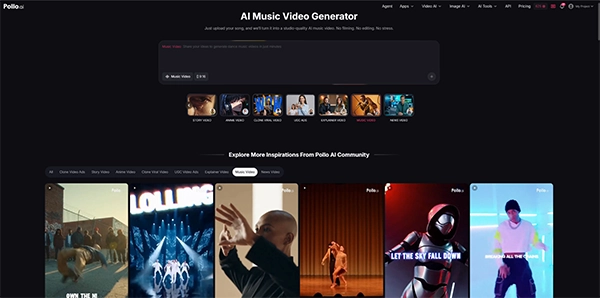
Pollo AI operates as a structured AI music video generator designed to convert songs into fully storyboarded visual narratives. It turns songs into videos; the user just needs to upload audio, and the rest of the work is done by the system itself. It maps the rhythm and mood and brings the perfect output that can be edited if something feels less satisfying. It has many creative modules like Music Video, Narrative Music Video, Lyric Video, and Anime Video that allow different outputs coming from the same song.
Beyond basic generation, Pollo AI supports advanced workflows including Text-to-Video AI, Image-to-Video AI, and Reference-to-Video consistency tools. This feature is important for creators to maintain characters and other elements throughout the whole music video. The system also comes with storyboard generation that prevents the need to manually design the scene progression. This AI music video generator creates a complete visual video output that matches your audio and lyrics.
Why Pollo AI stands out as an AI music video generator
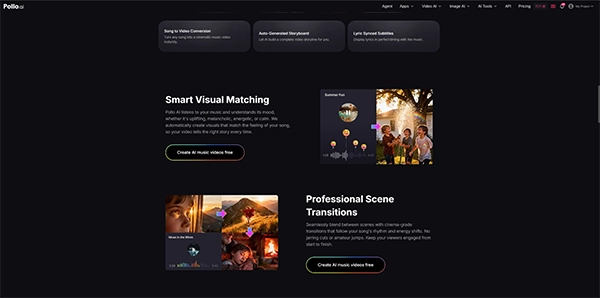
Pollo AI is one of the best AI music video generators among all options. Its strong automation and structured production bring outputs that actually work. The emotional tone detection by Smart Visual Matching also serves at its best by detecting energetic, calm, or melancholic tones that can be seen in the videos. These features work together to bring storytelling on point without the need for manual editing. The platform also provides professional-grade transitions that align with beat changes, helping maintain viewer engagement across short-form and long-form content, making it particularly suitable as an Instagram video maker for creators who need fast, visually consistent output optimized for social feeds.
Another key advantage lies in its scalability for commercial use cases. Independent musicians, agencies, and content creators can generate multiple music videos efficiently for different platforms like TikTok, YouTube, or Instagram. The Video Ads and UGC collaborations also spread its utility among traditional music and marketing opportunities.
My tips: While highly automated, users should still refine prompts and audio inputs carefully, as overly vague descriptions may lead to less precise visual interpretation.
Kling AI for cinematic motion and visual storytelling
Kling AI is an AI music video generator known for its cinematic motion rendering and strong temporal consistency. It focuses on producing visually coherent sequences with realistic camera movement, lighting dynamics, and scene depth. This is not a workflow-driven platform; it prioritizes high-quality storytelling that is based on the visuals it creates from the prompt.
The system is typically used to create music videos that resemble short films rather than abstract visual loops. It can interpret descriptive prompts and translate them into structured cinematic scenes.
While it does not inherently specialize in audio synchronization, it can still be used in AI music video generator pipelines by aligning generated clips with external music tracks during post-production editing. Its strength lies in producing visually polished scenes that can serve as the foundation for narrative-driven music videos.
Why Kling AI is valuable in AI music video generator workflows
Kling AI is valuable in the AI music video generator space because it excels at generating realistic motion and consistent visual environments.
This is very useful for creators who want to produce cinematic and grounded music videos. It also has the ability to maintain objects and characters consistently in all frames that improves the storytelling; this is the hardest thing for any other generative AI platforms.
It is especially suitable for narrative music videos, atmospheric soundtracks, and concept-driven visual storytelling. But it needs more manual alignment when syncing visuals to music timing.
My tips: Kling AI works best when prompts include detailed scene direction; otherwise, outputs may lack narrative focus.
Pika for rapid concept testing and visual experimentation
Pika functions as a fast-moving AI music video generator designed for experimentation and iterative content creation. It creates short videos for users very quickly; this makes this platform best for testing ideas before going for a full production project. The architecture works to quickly deliver the results and does not prioritize long-term production that much, so it is easier for users to test some quick explorations.
In music video workflows, Pika is often used to generate visual snippets inspired by rhythm, mood, or abstract prompt descriptions. These outputs can later be refined or combined in external editing tools. It does not provide strict consistency, but it gives a flexible approach to test different things earlier for creative ideas for AI music generator systems.
Why Pika is useful in AI music video generator pipelines
Pika is valuable because it significantly reduces the time required to explore multiple visual styles. Users can experience and go through different ideas, moods, and approaches they are thinking about, and every interpretations of a song can be altered in different scenarios before becoming a final project.
It is commonly used by content creators, social media editors, and experimental artists who prioritize output volume and creative diversity. But users should remember that it focuses on brainstorming ideas instead of perfect long-term outputs.
My tips: Pika is best used as a pre-production ideation tool rather than a final video generator for long music sequences.
Runway Gen-3 Alpha for advanced motion and professional control
Runway Gen-3 Alpha is a high-end AI music video generator widely used for its advanced motion synthesis and prompt control capabilities. This generative AI is best for creating complex scenes, camera movements, surroundings, and every other aspect that a perfect video should have, with high precision. Creators use this when they need professionalism in their work or where quality and visuals can not be compromised.
Although it is not inherently audio-driven, Runway Gen-3 Alpha can be integrated into AI music video generator workflows by synchronizing generated clips with externally produced audio tracks.
The major benefit is this can very perfectly produce visuals that are ready or require very minimal editing to work as music videos or bring cinematic appeal. It is very popular in fields like advertisements, filmmaking, digital storytelling, and others that require a professional finish.
Why Runway Gen-3 Alpha is important for AI music video generator use cases
Runway Gen-3 Alpha stands out in the AI music video generator category due to its strong emphasis on motion accuracy and scene stability. Creators are able to easily create realistic outputs that do not lack visual consistency and transitions. Music videos get controlled pacing and cinematic composition by using this platform.
It is particularly useful for professional editors and studios that need reliable generative outputs for post-production workflows.
But remember, prompt engineering is a thing that users should know. The more specifically you describe what you want, the more satisfying results you will get.
My tips: Runway performs best when users define clear camera and scene instructions rather than relying on abstract prompts.
Luma Dream Machine for realistic spatial and atmospheric video generation
Luma Dream Machine is an AI music video generator focused on producing realistic spatial environments and physically coherent motion. This AI model mimics authentic lighting, depth, environmental behaviour, and realistic surroundings that make the music video experience more polished. This focuses on providing more realistic results instead of more stylized outputs. This makes it different from other generative AI models.
Within music video production workflows, Luma Dream Machine is commonly used to create atmospheric sequences that work with ambient or narrative-driven audio tracks. While it does not directly specialize in beat-level synchronization, it can still function within AI music video generator pipelines. It works best when paired with external editing tools for timing alignment. Its results are very grounded in realistic motion physics and environmental consistency.
Why Luma Dream Machine fits AI music video generator production
Luma Dream Machine is valuable because it generates highly realistic environments that bring improved emotional immersion in AI music video generator projects. It works brilliantly whenever it comes to producing physically grounded spatial scenes, which makes it the best option for cinematic and ambient music videos. Creators can efficiently create very close-to-reality outputs that support storytelling with simplicity instead of heavy production after effects.
It is particularly effective for mood-based music videos, nature-inspired visuals, and narrative sequences that rely on realism.
The only thing to consider about this tool is that it offers less stylized results compared to other generative AI platforms, as it prioritizes realistic outputs.
My tips: Luma works best with descriptive environmental prompts rather than abstract artistic directions.
Conclusion
The AI music video generator landscape in 2026 reflects a balance between automation, cinematic control, experimentation, and realism. Pollo AI is great for structured workflows and automated storytelling, Kling AI works best for cinematic motion requirements, Pika is ideal for testing flowing ideas, Runway Gen-3 Alpha is the expert’s choice that serves professional-grade control, and Luma Dream Machine is the one that provides the most realistic environments.
Together, these platforms show that AI-driven music video creation is no longer experimental—it is becoming a practical production layer for modern digital media workflows.
Frequently Asked Questions
What is the main use of Pollo AI?
How is Kling AI best for cinematic and realistic video generation?
Kling AI focuses on realistic motion, camera movement, lighting, and maintaining consistency in scenes; that’s why it is considered the best AI tool for cinematic and realistic video generation.
What is the difference between Pika and Runway Gen-3 Alpha?
The difference between Pika and Runway Gen-3 Alpha is:
Pika focuses on fast experiments and creates short videos, but Gen-3 Alpha prioritizes advanced motion control and professional video production.