Connected detectors are IoT-enabled devices that continuously collect and transmit data about building conditions, equipment performance, occupancy, energy usage, and environmental factors to a centralized monitoring platform.
How Connected Sensors Improve Facility Monitoring

Updated On August 4, 2026

“You can’t manage what you don’t measure.” – Peter Drucker (Management Expert)
This principle is pertinent to modern facility management. Buildings today generate enormous amounts of operational data every minute, from HVAC performance and energy consumption to occupancy levels, indoor air quality, and equipment health. Yet according to industry research, unplanned downtime remains one of the biggest operational expenses for facilities, costing organizations thousands of dollars per hour in many commercial and industrial settings.
Connected sensors help here by providing continuous, real-time data on operations. Instead of relying on routine inspections or reacting after equipment fails, facility managers can detect issues early, automate responses, and make data-driven decisions that improve efficiency, reduce downtime, and enhance safety across commercial, healthcare, educational, and industrial facilities.
Table of Contents:
Real-Time Data Improves Visibility
Connected detectors collect data continuously. That data is instantaneously transmitted to centralized monitoring platforms. Facility managers gain immediate insight into changing conditions without physically inspecting every location.
Detectors can monitor:
- Temperature
- Humidity
- Air quality
- Motion
- Water leaks
- Power consumption
- Equipment vibration
- Occupancy
There are also some specialized sensors. For example, vape detectors can monitor designated indoor spaces for vaping incidents and detect changes in environmental conditions that require a lookout. Integrating these sensors with the centralized building management does two things: first, it improves visibility, and second, it helps with faster incident response.
Real-time monitoring allows maintenance teams to identify abnormal readings before they grow into equipment failures or safety concerns.
Reduce Downtime Through Predictive Maintenance
Traditionally, maintenance happened on fixed scheduled timings. The equipment condition wasn’t taken into consideration. It could be not working at all or working perfectly; it didn’t matter. Connected sensors support predictive maintenance by identifying performance changes that indicate developing problems.
For example, sensors can immediately alert to an HPLC machine failure that can disrupt a healthcare facility’s operations. This becomes urgent when it’s a question of life and death.
Before absolute failure, equipment signals wear and tear by symptoms like:
- Increasing vibration
- Abnormal motor temperatures
- Unexpected power consumption
Addressing these issues early reduces repair costs and minimizes operational disruptions.
Speaking of repairs, if your phone isn’t working properly, head to the best smartphone repair service in New York.
Monitor Critical Building Systems
Some equipment impacts operations more than others. Facilities often prioritize sensor deployment on that equipment.
Common monitoring applications include:
- HVAC performance
- Electrical panels
- Water leak detection
- Refrigeration equipment
- Backup power systems
Continuous monitoring indirectly improves equipment reliability as it spots any small malfunction symptoms. This helps maintenance teams allocate resources more efficiently.
Improve Environmental Control
Environmental conditions directly affect both building occupants and sensitive equipment. In addition to bothering the workforce, equipment damage risk rises as you increasingly encounter:
- Temperature fluctuations
- Excessive humidity
- Poor air quality
Sensors alert facility managers as soon as these metrics breach threshold points. This helps keep indoor conditions stable and risk-free.
Historical trend analysis also helps identify recurring problems, such as inconsistent cooling performance or ventilation deficiencies that may otherwise remain unnoticed.
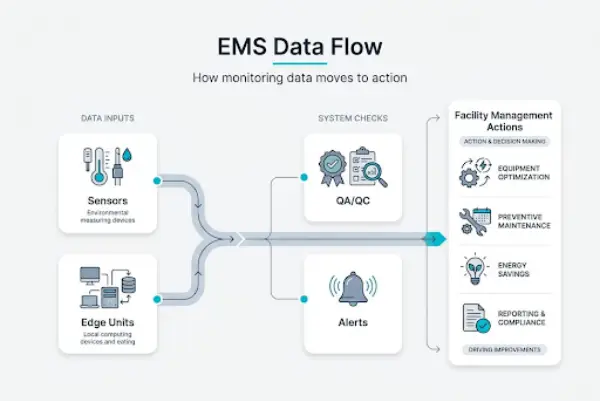
This is how environmental monitoring systems data moves across sensors and facility management systems:
Strengthen Building Security
Modern sensor networks extend beyond environmental monitoring. Automated building operations stand on valuable security information that’s gathered by:
- Motion sensors
- Door contacts
- Occupancy sensors
- Access control devices
Enable Faster Incident Response
Centralized monitoring platforms can generate immediate notifications when unusual activity is detected.
Examples include:
- Unauthorized room access
- Water leaks
- Smoke or environmental alarms
- Unexpected equipment shutdowns
With automated alerts, facility personnel can respond quickly to these adverse incidents. This saves the facility from operational failures and security incidents.
Integration with existing security systems also improves coordination between maintenance and security teams during emergencies.
Support Data-Driven Decision Making
Connected sensors generate operational data that extends well beyond immediate alerts.
Facility managers can analyze trends to identify inefficient equipment, optimize maintenance schedules, reduce energy consumption, and improve long-term capital planning. Performance reports also point to the equipment that’s approaching end of life. This helps in better budgeting.
Instead of relying on assumptions, organizations can prioritize investments using measurable operational data collected over time.
Simplify Multi-Site Facility Management
Most firms operate across multiple buildings. The problem is they often struggle to maintain consistent oversight across locations.
Cloud-based monitoring platforms provide a single interface to facility managers, easing the process of reviewing:
- Equipment status
- Environmental conditions
- Alarm activity
Standardized reporting makes it easier to compare buildings. The insights help organizations identify recurring operational issues.
Remote monitoring also reduces unnecessary site visits by allowing maintenance personnel to evaluate many alerts before dispatching technicians.
Plan for Scalable Sensor Networks
As organizations grow, so do their facilities. And concurrently, the needs of that facility also change. Sensor infrastructure should be such that it doesn’t collapse in case the facility expands in the future. In such a situation, it shouldn’t require a complete system replacement.
When selecting monitoring solutions, consider communication protocols, integration capabilities, cybersecurity protections, and compatibility with existing building management systems. Scalable platforms make it easier to add new sensors as operational requirements evolve.
If you oversee expansion in the future, better plan for it now. It helps reduce implementation costs while supporting long-term technology investments.
Conclusion
Connected sensors have transformed facility monitoring by replacing periodic inspections with continuous, data-driven oversight. Real-time monitoring, predictive maintenance, environmental control, and centralized reporting help organizations improve reliability. Operational risk is also minimized at the same time.
By deploying scalable sensor networks and integrating critical building systems, facility managers can make faster decisions, improve resource allocation, and maintain safer, more efficient environments.
FAQs
What are connected facility sensors?
How do connected sensors reduce maintenance costs?
Continuous monitoring allows maintenance teams to address issues before they result in costly equipment failures or unplanned downtime.
What types of facilities benefit from connected sensors?
Connected detectors are widely used in commercial office buildings, hospitals, schools, manufacturing plants, warehouses, data centers, retail stores, and other facilities where continuous monitoring improves operational efficiency and safety.